With Friends Like Obama, Who Needs Enemies?!

For Religious Minorities in the Middle East
– With Friends Like Obama, Who Needs Enemies?!

President Obama has an amazing ability to make Jimmy Carter’s foreign policies look good.

Iraqis wave their national flag during a celebration marking the withdrawal of US troops from Iraq in Baghdad's Adhamiyah neighborhood on December 30, 2011.

Opposition to imperfect allies and support of radical Islamists has resulted in the almost-extinction of religious freedom for religious minorities – from the Copts in Egypt to the defenseless women and children who were slaughtered in Homs, Syria – in the Middle East.

Another example is the devolving situation in Iraq. President Obama was so committed to fulfilling an arbitrary campaign promise to get our troops out of Iraq that he ignored the advice of his senior military officials about the consequences of establishing a firm withdrawal date and about how long it might take before Iraq was ready to manage the situation on their own. As a result, Al-Qa’ida is resurgent, Iran’s influence is greater than ever, religious tensions between Sunni and Shi’a are increasing, the existential threat facing Iraq’s indigenous minority communities has never been greater, and our ability to affect the situation there is weaker now. Recent coordinated car bomb attacks are just the latest in a string of such events since the start of the new year, and they portend many more violent assaults to come.

The departure of our military forces has once again left a security vacuum that is bound to be filled by someone, and all those with the means to vie for that space will do so, whether Sunni insurgents, terrorists like Al Qa’ida, security forces controlled by the ruling Shi’a political establishment, and in parts of the country even Kurdish Peshmerga. These machinations undermine institutionalizing the rule of law, protecting minority rights, or developing the economy and infrastructure, let alone advancing American interests in that country and the region.

The most vulnerable people in this situation also happen to be the ones most aligned with our values and interests. These are Iraq’s besieged Christians – the Chaldeans, Assyrians, Syriacs and Armenian Orthodox communities. The role their faith has played in developing their worldview is far more in keeping with America’s values than any other constituency in the country or the region. Moreover, because these communities have an ethic that places a premium on education, entrepreneurship, and peaceful co-existence and respect for others, they have constituted a disproportionately large part of the upper-middle class, they have historically contributed far more to the country’s economy than their numbers would suggest, and they have been the most trusted elements of Iraqi society. They also have a much greater respect for the value of the rule of law, they were the ones who came along side our military, diplomats, and contractors to provide translation services and cultural advice.

With the departure of our forces and the recent announcement of the Obama Administration that we will also be reducing our embassy staff by 50 percent because it is now too dangerous for our diplomats there we are effectively abandoning both Iraq and our investment there as well as the communities who risked the most to help us in that effort. What is more, walking away like this also sends messages to other players in the region. It signals to potential allies in the future that we are not dependable. It signals to terrorists that if they just lay low, they can wait us out. It signals to the world that we no longer have the resolve to see a situation through to the end – that we can’t finish what we started.

We need all the help we can get in that part of the world, and Iraq’s Christians are the ones most inclined to provide that help, but not if doing so is only going to increase the prospect of their genocidal annihilation.

Accordingly, we need a comprehensive policy aimed at preserving these communities in Iraq. We need to focus on helping Iraqis create the conditions that incentivize staying in Iraq and making there a better future for themselves. The last thing we want is for them to abandon the land their ancestors have occupied for nearly 7,000 years,forsake the culture they have preserved in that volatile region for all these millennia, and deprive the country, the region, and the world of the positive contributions they could still make if only some space was created for them in Iraqi society. These people – who are all but canaries in a coal mine – represent hope for a better future for a pluralistic Iraqi society.

First, they need security. By “security,” though, I mean more than just safety from terrorist and insurgent attacks. I mean they need the means to protect themselves and their own communities so they do not have to depend on political actors whose interests are not necessarily aligned with the needs of their own communities. They should not be subjected to political shakedowns and corrupt political machinations.

Second, they need political empowerment. They have the right to some degree of self-determination and to have a say in how their local communities should be governed. It is wrong for them to be treated as a political football, constantly crushed between manipulative forces that surround them.

Third, they need economic development in the region where they now find themselves. Having been forced off their ancestral lands in the last century, they reestablished themselves in the cities such as Baghdad and Basra. In the aftermath of the second Gulf War, though, they have had to seek refuge back in the North again. Yet this region was not developed very well under Saddam’s regime, and today’s Iraqi Christians are disproportionately of the urban professional class rather than farmers.

It is time that we stand with those who stood with us over the last 8 years. We must not abandon them. I will stand with those who stand for freedom of religion and conscience and against violent jihadism and persecution of religious minorities in Iraq, Egypt, and elsewhere.

Odierno: Army could drop to 32 brigades

By Kate Brannen – Staff writer
Posted : Friday Feb 24, 2012 9:26:03 EST
FORT LAUDERDALE, Fla. — Army Chief of Staff Gen. Ray Odierno said Friday the Army could drop from today’s 45 brigades down to 32, depending on the results of an internal Army study.

With the unveiling of the new DoD strategic guidance in January, the Pentagon announced the Army would eliminate at least eight brigade combat teams and drop from 570,000 soldiers in the active duty force to 490,000. Army officials have said the number of brigade combat teams could fall even further with the conclusion of a force design/force mix study being done by Army Training and Doctrine Command (TRADOC).

The major brigade change TRADOC is considering is adding a third maneuver battalion to the brigades.

Increasing the number of battalions within the brigades would add “significant flexibility,” Odierno said at the Association of the U.S. Army winter symposium.

The Army is also considering adding more engineer capability within the brigade.

Both of these moves could allow the Army to eliminate more brigades, down to 32 or 33 brigades, the four-star said.

TRADOC will make its recommendations in the coming months to Army Secretary John McHugh, who will make the final decision, according to Odierno. MORE HERE

How can the Military be expected to do the job assigned to them by the US Constitution is they are ill-equipped and undermanned?

You Think Thomas Jefferson Embraced the Koran? Think Again!


You may think the rising tide of radical Islam is a relatively new thing, especially as it relates to America, but it is not.

America and the Barbary Pirates:
An International Battle Against an Unconventional Foe

by Gerard W. Gawalt
Gerard W. Gawalt is the manuscript specialist for early American history in the Manuscript Division, Library of Congress.

“The ruthless, supremely committed element of radical Islam we face today are not new to the United States of America.

More than two hundred years ago the newly established United States faced Muslim pirates that were the scourge of the Mediterranean Sea and a significant area of the North Atlantic. Their practice was to attack any and every ship and ransom the captives. Pirate ships and crews from the North African states of Tripoli, Tunis, Morocco, and Algiers (the Barbary Coast) became the extortionists of the seas and presented a radically different threat to the young American nation.

“Before the United States obtained its independence in the American Revolution, 1775-83, American merchant ships and sailors had been protected from the ravages of the North African pirates by the naval and diplomatic power of Great Britain. British naval power and the tribute or subsidies Britain paid to the piratical states protected American vessels and crews. During the Revolution, the ships of the United States were protected by the 1778 alliance with France, which required the French nation to protect “American vessels and effects against all violence, insults, attacks, or depredations, on the part of the said Princes and States of Barbary or their subjects.”

After the United States won its independence in the treaty of 1783, it had to protect its own commerce against dangers such as the Barbary pirates. As early as 1784 Congress followed the tradition of the European shipping powers and appropriated $80,000 as tribute to the Barbary states, directing its ministers in Europe, Thomas Jefferson and John Adams, to begin negotiations with them. Trouble began the next year, in July 1785, when Algerians captured two American ships and the dey of Algiers held their crews of twenty-one people for a ransom of nearly $60,000.” (Gawalt)

    “How many know that perhaps 1.5 million Europeans and Americans were enslaved in Islamic North Africa between 1530 and 1780? We dimly recall that Miguel de Cervantes was briefly in the galleys. But what of the people of the town of Baltimore in Ireland, all carried off by “corsair” raiders in a single night?

    Some of this activity was hostage trading and ransom farming rather than the more labor-intensive horror of the Atlantic trade and the Middle Passage, but it exerted a huge effect on the imagination of the time—and probably on no one more than on Thomas Jefferson. Peering at the paragraph denouncing the American slave trade in his original draft of the Declaration of Independence, later excised, I [Christopher Hitchens] noticed for the first time that it sarcastically condemned “the Christian King of Great Britain” for engaging in “this piratical warfare, the opprobrium of infidel powers.” The allusion to Barbary practice seemed inescapable.” (Jefferson Versus the Muslim Pirates)

In 1786, Thomas Jefferson and John Adams met with Tripoli’s ambassador to Great Britain to ask him by what right his nation attacked American ships and enslaved American citizens. He claimed that the right was founded on the laws of their prophet and that it was written in the Koran that all nations that didn’t acknowledge their authority were sinners, and that not only was it their right and duty to make war upon these sinners wherever they could be found, but to make slaves of all they could take as prisoners, and that every Muslim slain in battle was guaranteed a place in Paradise. Despite this stunning admission of pre-meditated violence on non-Muslim nations, as well as the objections of numerous notable Americans, including George Washington, who warned that caving in was both wrong and would only further embolden their enemy, the United States Congress continued to buy off the Barbary Muslims with bribes and ransom money.

They paid Tripoli, Tunis, Morocco, and Algiers upwards of one million dollars a year over the next fifteen years, which by 1800 amounted to 20% of the United States annual revenues. Jefferson was disgusted. To add insult to injury, when he was sworn in as the third president of the United States in 1801, the pasha of Tripoli sent him a note demanding an immediate payment of $225,000 plus $25,000 a year thereafter. That was when everything changed!

Jefferson let the pasha know in no uncertain terms what he could do with his demand. The pasha responded by chopping down the flagpole in front of the US Consulate and declaring war on the United States. Tunis, Morocco and Algiers followed suit.” (The Last Patriot, by Brad Thor)

“Thomas Jefferson, United States minister to France, opposed the payment of tribute, as he later testified in words that have a particular resonance today. In his autobiography, Jefferson wrote that in 1785 and 1786 he unsuccessfully “endeavored to form an association of the powers subject to habitual depredation from them. I accordingly prepared, and proposed to their ministers at Paris, for consultation with their governments, articles of a special confederation.” Jefferson argued that “The object of the convention shall be to compel the piratical States to perpetual peace.” Jefferson prepared a detailed plan for the interested states. “Portugal, Naples, the two Sicilies, Venice, Malta, Denmark and Sweden were favorably disposed to such an association,” Jefferson remembered, but there were “apprehensions” that England and France would follow their own paths, “and so it fell through.”

Paying the ransom would only lead to further demands, Jefferson argued in letters to future presidents John Adams, then America’s minister to Great Britain, and James Monroe, then a member of Congress. As Jefferson wrote to Adams in a July 11, 1786, letter, “I acknolege [sic] I very early thought it would be best to effect a peace thro’ the medium of war.” Paying tribute will merely invite more demands, and even if a coalition proves workable, the only solution is a strong navy that can reach the pirates, Jefferson argued in an August 18, 1786, letter to James Monroe: “The states must see the rod; perhaps it must be felt by some one of them. . . . Every national citizen must wish to see an effective instrument of coercion, and should fear to see it on any other element than the water. A naval force can never endanger our liberties, nor occasion bloodshed; a land force would do both.” “From what I learn from the temper of my countrymen and their tenaciousness of their money,” Jefferson added in a December 26, 1786, letter to the president of Yale College, Ezra Stiles, “it will be more easy to raise ships and men to fight these pirates into reason, than money to bribe them.”

“Jefferson’s plan for an international coalition foundered on the shoals of indifference and a belief that it was cheaper to pay the tribute than fight a war. The United States’s relations with the Barbary states continued to revolve around negotiations for ransom of American ships and sailors and the payment of annual tributes or gifts. Even though Secretary of State Jefferson declared to Thomas Barclay, American consul to Morocco, in a May 13, 1791, letter of instructions for a new treaty with Morocco that it is “lastly our determination to prefer war in all cases to tribute under any form, and to any people whatever,” the United States continued to negotiate for cash settlements. In 1795 alone the United States was forced to pay nearly a million dollars in cash, naval stores, and a frigate to ransom 115 sailors from the dey of Algiers. Annual gifts were settled by treaty on Algiers, Morocco, Tunis, and Tripoli.

When Jefferson became president in 1801 he refused to accede to Tripoli’s demands for an immediate payment of $225,000 and an annual payment of $25,000. The pasha of Tripoli then declared war on the United States. Although as secretary of state and vice president he had opposed developing an American navy capable of anything more than coastal defense, President Jefferson dispatched a squadron of naval vessels to the Mediterranean. As he declared in his first annual message to Congress: “To this state of general peace with which we have been blessed, one only exception exists. Tripoli, the least considerable of the Barbary States, had come forward with demands unfounded either in right or in compact, and had permitted itself to denounce war, on our failure to comply before a given day. The style of the demand admitted but one answer. I sent a small squadron of frigates into the Mediterranean. . . .”

The American show of force quickly awed Tunis and Algiers into breaking their alliance with Tripoli. The humiliating loss of the frigate Philadelphia and the capture of her captain and crew in Tripoli in 1803, criticism from his political opponents, and even opposition within his own cabinet did not deter Jefferson from his chosen course during four years of war. The aggressive action of Commodore Edward Preble (1803-4) forced Morocco out of the fight and his five bombardments of Tripoli restored some order to the Mediterranean. However, it was not until 1805, when an American fleet under Commodore John Rogers and a land force raised by an American naval agent to the Barbary powers, Captain William Eaton, threatened to capture Tripoli and install the brother of Tripoli’s pasha on the throne, that a treaty brought an end to the hostilities. Negotiated by Tobias Lear, former secretary to President Washington and now consul general in Algiers, the treaty of 1805 still required the United States to pay a ransom of $60,000 for each of the sailors held by the dey of Algiers, and so it went without Senatorial consent until April 1806. Nevertheless, Jefferson was able to report in his sixth annual message to Congress in December 1806 that in addition to the successful completion of the Lewis and Clark expedition, “The states on the coast of Barbary seem generally disposed at present to respect our peace and friendship.”

“In fact, it was not until the second war with Algiers, in 1815, that naval victories by Commodores William Bainbridge and Stephen Decatur led to treaties ending all tribute payments by the United States. European nations continued annual payments until the 1830s. However, international piracy in Atlantic and Mediterranean waters declined during this time under pressure from the Euro-American nations, who no longer viewed pirate states as mere annoyances during peacetime and potential allies during war. MORE HERE

“Among the more intriguing stories, the USS Philadelphia, a 44-gun Navy frigate, ran aground off Tripoli in October 1803. The Tripolitans forced the captain and crew to surrender, and they used the Philadelphia for harbor defense against the Americans. On Feb. 16, 1804, Lt. Stephen Decatur, using a captured Tripolitan boat, led a contingent of Marines to seize the Philadelphia and burn it. They also briefly captured Tripoli, but they didn’t recover the captain or crew. Decatur became the first military hero since the Revolution and became a commodore, who kicked more ass in the Second Barbary War in 1815. Tripoli was again captured, and the pirates surrendered in 1805. This is why the Marine Hymn has the phrase, “. . .to the shores of Tripoli.”

Thomas Jefferson understood the same thing Ronald Reagan understood … that the best position for negotiation is from a position of strength. He quickly realized that though he was pledged to “religious freedom,” the brand of Islam involved in this slave trade taught him Islam was not just a religion but a political system as well. The fact that President Obama continues to dismantle and understaff our military, and fail to give them a specific and clear “winnable” objective demonstrates either his lack of resolve OR his resolve to our destruction.


*NOTE: All notations to quoted text are done by blogsensebybarb for emphasis.

RELATED ARTICLES:

  • What Thomas Jefferson learned from the Muslim book of jihad
  • The United States Fought Wars Against North African Pirates in the Early 1800s: Thomas Jefferson Wouldn’t Give In to the Barbary Pirates
  • CAIR: CIVIL RIGHTS ADVOCATES OR RADICAL ISLAMISTS?
  • How Did the United States Defeat the Barbary Pirates?
  • Jefferson Versus the Muslim Pirates
  • Outraged?


    LAWMAKERS SPONSOR A RESOLUTION CONDEMNING DEATH SENTENCE FOR IRANIAN CHRISTIAN PASTOR

    Through The Blaze’s coverage, you may be familiar with Youcef Nadarkhani, an Iranian Christian pastor sentenced to death for refusing to renounce his faith and convert back to Islam. Now, Congressional lawmakers are standing in solidarity with the beleaguered faith keeper.

    Rep. Joseph Pitts (R-PA) has sponsored a resolution denouncing Iran for its ruling of apostasy against Nadarkhani and calling for his immediate release

    “Iran has become more isolated because of their drive for nuclear weapons, and the fundamentalist government has stepped up persecution of religious minorities to deflect criticism,” Pitts told FoxNews. “The persecuted are their own citizens whose only crime is practicing their faith.” More Here

    Our Sacred Honor

    The monument was designed primarily by Boston sculptor Hammatt Billings. As large as the Forefathers Monument stands, Billings’ original design called for it to be nearly twice as high at 150 feet (just under the Statue of Liberty’s height, including the pedestal, of 151 feet). The monument features several allegorical figures depicting virtues the Pilgrims, known in Plymouth as the Forefathers, brought with them when they arrived in Massachusetts in 1620. A dedication on the monument’s northeast face reads, “National Monument to the Forefathers. Erected by a grateful people in remembrance of their labors, sacrifices and sufferings for the cause of civil and religious liberty.”

    Rick Santorum’s stirring speech, invoking the Founders’ pledge of “our lives, our fortunes, and our sacred honor” to the cause of liberty, neatly encapsulates the problems of the Republican primary field: Romney has no life, Santorum no fortune, and Gingrich no sacred honor. (Kevin D. Williamson)

    Honor is a word we don’t hear too much about any more. A shame. It is not just an interesting concept, but it is a powerful character attribute that has all but disappeared in today’s America. “We need to be the voice for freedom. And that founding document, the Declaration of Independence, at the end of that document, those founders signed their names. But the last clause of that document said we pledge our lives, our fortunes and our sacred honor. [...] America’s honor, your honor is at stake. Go out and preserve the greatest country in the history of the world.” Said Santorum.

    Santorum is correct when he says America’s honor is at stake. But what exactly is honor?

    Congressional Medal of Honor awarded for service above and beyond the call of duty.

    “While most of us think of honor as title, prestige or fame, I think the Marines have the best grasp of the concept: “honor guides those who do the right thing when no one is looking. It is not only a duty, but a distinction, as those who possess honor are held in honor. It’s found in one’s beliefs, but exhibited through one’s actions.”

    “America leads best when she leads by example. This means we need leaders who have the humility to keep our country a nation of laws – not of strongmen – and restore honor to our government institutions. We need to be consistent and live by the rule of law, even when it’s inconvenient to personal or passionate mob agendas.

    “Before we can protect America’s borders or overseas interests, we first have to protect America’s heart, and honor needs to once more be our breastplate of righteousness.

    “We need to honor life, liberty and private property and make our nation worthy of the manifold sacrifices that have been poured out on the altar of freedom. We need to do unto others as we would have them do unto us and keep our country’s policies above reproach.

    “Our honor rests on what we do or fail to do in this election, starting now. Remember this: no foreign enemy can defeat, humiliate or dishonor the United States – only Americans can do that.” (Full Article here)

    General MacArthur put it as well as anybody ever has, “Duty, Honor, Country: Those three hallowed words reverently dictate what you ought to be, what you can be, what you will be. They are your rallying points: to build courage when courage seems to fail; to regain faith when there seems to be little cause for faith; to create hope when hope becomes forlorn. Unhappily, I possess neither that eloquence of diction, that poetry of imagination, nor that brilliance of metaphor to tell you all that they mean.

    The unbelievers will say they are but words, but a slogan, but a flamboyant phrase. Every pedant, every demagogue, every cynic, every hypocrite, every troublemaker, and, I am sorry to say, some others of an entirely different character, will try to downgrade them even to the extent of mockery and ridicule.”

    The concept in our culture originated, like so many things, with the early residents, both those Native Americans and those newly arrived Americans who sought to live “honorably.” Of course, it meant two different things to the two different cultures, and it is a sad commentary on the European settlers that they soon learned that honor didn’t earn them as much green as trickery. Many of these Europeans thought they were more intelligent because they chose wealth over honor. Many Americans today make that same assumption when they choose their careers, or their wealth over honor.

      The Founders did not merely want to be independent of England. It was about more than import duties and having a voice in the British parliament. Christian Patriots caught fire. They realized that America, a land set apart, could be a society set apart too: the world’s first experiment in self-government, a Republic (not a democracy, which is a subject for a thousand posts), and, when we read the documents of the time, a civil society built along biblical principles. Even “deists” – fewer in number than modern textbooks claim – looked to the Bible for blueprints.

      Revolution? Jefferson wrote, “The tree of liberty must be refreshed from time to time with the blood of patriots and tyrants.” Significantly, he wrote this after the Constitution had been adopted.

    What might it mean when people take an Oath, a sacred Oath, a Holy Oath to serve America and their American peers or later generations desecrate that Oath and by doing so the “sacred Honor” of our collective ancestors? Contrary to today’s mindset, America has for generations actually served as the “light on the hill” for multitudes of immigrants. It is not a new idea. But past generations understood there was a code – an “honor code” within the American culture. There have always been criminals and bullies, but they were and are a distinct minority easily overcome by the goodness, the generosity, the kindness of most Americans because we had an understanding America didn’t belong to us alone. It belonged to our parents and grandparents, it belonged to the Pilgrims, the merchants, the farmers that first settled this land.

    It also belonged to the Native Americans that were so dishonored by those among us who lacked honor, almost to the destruction of the nation. Likewise with slavery, even within a culture that proclaimed honor, the dishonor to fellow humans nearly destroyed us.

    Today, once again, there has arisen in our midst, a number of Americans without any sense of honor, and they threaten to destroy our nation’s very foundation. A multitude of tools and ploys have been released in our midst to distract us, confuse us, and dissuade us they even exist. But let me ask you this, friends: Is America better off today than it was a decade ago? Two decades ago? Two years ago?

    Though there is corruption in Washington DC, is there not also corruption in your town, your neighborhood? Is there more or less strife within your home now than 5 years ago? What is the source?

    I propose, it is further evidence of the moral decay in our nation in the guise of political correctness. (Political Correctness is merely the resentment of spoilt children directed against their parent’s values.) We must look within ourselves. Does any trace of sacred honor dwell in me, in my life? Do my words and actions resonate with echos of sacred honor sufficient to match those who preceeded me or enough to carry forward to my children and grandchildren?

    President Lincoln once said, “You can please (or fool) some of the people all of the time, and all of the people some of the time, but you can not please (or fool) all of the people all of the time.” In the effort to avoid offending one, we offend another, yet we’ve accepted this as freedom. It is not! It is a far cry from freedom. It is mob tyranny – might makes right – which is a poor relative of personal freedom as put forth in our Declaration of Independence.

    I challenge you to read this beloved Founding document again, and think about the sacred oath these men (and the women beside them) made to this infant nation, to each other, and to God. We are not in this freedom fight alone! We are joined by the honor of those who loved Freedom before us, and we are accountable to our children and our grandchildren and countless generations yet to come to stand fast, there, in the liberty foreseen by those who came before us and dreamed about by those who will follow us.


    And for the support of this Declaration,
    with a firm reliance on the protection of Divine Providence,
    we mutually pledge to each other
    “Our lives, our fortunes, our sacred honor”

    So, uh, What Do We Want? Obama? – Corruption? – Morality?

    What the heck do we want??? We have several choices available.

      1. Do we want moral or corrupt?

      2. Do we want a man of the people or a man with no clue how most of us live?

      3. Do we want socialism or liberty?

      4. Do we want “nanny state” or self-reliance?

      5. Do we want leaders to be accountable & responsive to the people or the people dependent on the leaders?

      6. Do we want a man who knows all the right things to say or a man who lives the way he speaks?

      7. Do we want a man who has a work history or a man who has never held a real job?7

    What Do We Want? Obama? – Corruption? – Morality?


    It is still early in this primary process, but many of us have chosen our favorite. For those who have not, or for those who are on one or more fences, just thought I’d ask who among us actually believes that “Satan” (figurative or undefined evil) has grown in our nation over the past decades? NO! it is not all Obama’s responsibility, but neither has he – as leader of the Free World – done anything to counter the declining morality in our culture that infects education, business, Wall Street, security, and every other facet of our daily lives. Crime goes up, so does insurance, so do law suits, so do taxes to pay law enforcement officials. Like it or not, the availability of condoms and other forms of birth control have not diminished the number of un-wanted pregnancies, as we were told would happen last decade. In fact, the number of those unwanted pregnancies is actually up. Hm you don’t suppose Sen Santorum actually has a point?

    None of us believe he (or anyone else) should compel others to adhere to their morality inside or outside politics. Does that mean Santorum is not allowed to voice his opinion? even his wish? The US Constitution clearly prohibits proselyting from one faith to another in the political realm. The conflict, as I’ve written before, is that it is virtually impossible to allow those who worship no god to do so freely and simultaneously to allow those worship the traditional Judeo/Christian God to worship freely. The logical concession then, is for the Atheists to concede since the worship of no god is rather impossible to define.

    Santorum Calls Out Obama’s Boss

    Is the media really trying to convince us that someone other than Satan himself has taken over America? It didn’t start with Obama, but we could at least begin to take our country back by being rid of Obama next election.

    So Santorum gives a speech in 2008 insulting Satan and that’s a problem? A current president who pronounces us no longer a Christian nation, parties with notorious anti-semites and detests the Prime Minister of Israel—none of that is worthy of mention?

    Obama’s latest War on Goodness is his assault on the Catholic Church. He won’t let up until we abandon our current faiths and consecrate ourselves to the Church of State. He thinks we’re all Obamadans now.

    In Obamanutz: A Cult Leader Takes the White House, I laid it all out for you—how the left has nearly destroyed America by taking over our institutions. We have Bill Ayers-approved agendas in our public schools. The entertainment industry is a mere front organization for Satan himself (with the exception of country music). Our pop culture has putrified to the degree that a significant percentage of our population was busy worshipping a dead, alleged pedophile as young Neda lay dying in the streets of Tehran.

    Let’s just hope Santorum isn’t your average Republican and won’t buckle under pressure and apologize to Lucifer for his offensive comments.

    And who but Satan could have produced George Soros?

    Santorum Makes the Case – and Means it!

    Everyone at CPAC says things that conservatives like to hear. That, after all, is the purpose of CPAC. This year, of course, the most important speakers were the presidential candidates. As per the rule, all of them (apart from Ron Paul, who was absent) said things that played well with the audience. Only one, however, said the things that are most needful in this all-important year, and said them with a conviction that one can believe will continue, not only for the remainder of the campaign, but for the remainder of his political career. This was Rick Santorum.

    All three men stressed the urgency of defeating President Obama, saving the damaged economy, and repealing Obamacare. The similarities ended there. And as the constitutionalist argument at CPAC is between Santorum and Newt Gingrich—few constitutionalists mistake Mitt Romney for a kindred spirit—a brief comparison of their respective speeches will be instructive.

    Gingrich made some big promises, not just for Day One, as is presidential custom, but even for the weeks prior to his inauguration. “My goal, with your help, is that by the time President Obama lands in Chicago [on January 20th], we will have repudiated at least forty percent of his government on the opening day.” Okay, that isn’t going to happen, but campaign hyperbole is part of the game, right? Fine. The real problem with Gingrich’s speech, as with his thinking about goals in general, is that the focus is almost always on government, and how it can bring about the desired “results”—that is, the practical outcomes that collectively spell prosperity. MORE HERE

    What’s Happened to the TEA Party?

    Looks lie the TEA Party has lost its direction, its definition, and its goals. While in preparation for the 2010 Election, the TEA Party was engaged and unified behind representative candidates, as we ride the waves of the Presidential Primary, the TEA party is anything BUT unified. In fact, there seems to be no direction or expectation for the TEA party. TEA party members are backing each of the 4 candidates. How can this be, when they are very different?

    What they are trying to do is to create an America very unlike the America that has existed for centuries — the America that people have been attracted to by the millions from every part of the world, the America that many generations of Americans have fought and died for…The thing most associated with America – freedom – is
    precisely what must be destroyed if this is to be turned into a basically different country to suit Obama’s vision of the country and of himself. ~ Thomas Sowell

    Obama plays the “God” card, but the media jumps all over Santorum when he does?

    MY TAKE:

  • Social/small business/manufacturing conservatives – Santorum
  • Fiscal/constitutional conservatives/libertarians – Ron Paul
  • “He’s the only one who can beat Obama” position/RHINO’s – Romney
  • Excellent debater & politician – Newt
  • This is the time to CHOOSE which of these men BEST represents your views on EACH of the many topics and issues our nation faces. This is the time to decide … then get on board and get involved.

    And may the BEST Candidate win the nomination!

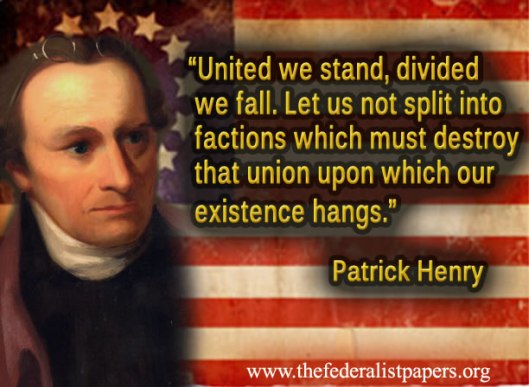
    THEN … we must set aside our differences, and support the nominee. As hard as it may be, any of these 4 men is a significant improvement over the current occupant of the Whitehouse! Right? Many of us will be disappointed with the nominee, but unity – majority in numbers is our strength, and we MUST unite. I’m saying it now so we can think about it, pray about it, adjust our mentality in that direction. The only way to get Obama out is to vote together to put one of these men into the Whitehouse. Which one will it be? Too early to tell, but I have my favorite. Do you?

    from TEA Party Movement Platform:

    Preamble: The Tea Party Movement is an all-inclusive American grassroots movement with the belief that everyone is created equal and deserves an equal opportunity to thrive in these United States where they may “pursue life, liberty and happiness” as stated in the Declaration of Independence and guaranteed by the Constitution of the United States.

    No one is excluded from participation in the Tea Party Movement. Everyone is welcomed to join in seeking to achieve the Tea Party Movement goals, which are as follows:

    1. Eliminate Excessive Taxes – Excessively high taxes are a burden for those exercising their personal liberty to work hard and prosper as afforded by the Constitution. A fiscally responsible government protects the freedom of its citizens to enjoy the fruits of their own labor without interference from a government that has exceeded its necessary size, scope and reach into the lives of its citizens.

    “Collecting more taxes than is absolutely necessary is legalized robbery.” –Calvin Coolidge

    “A wise and frugal government, which shall leave men free to regulate their own pursuits of industry and improvement, and shall not take from the mouth of labor the bread it has earned – this is the sum of good government.” –Thomas Jefferson

    “Any tax is a discouragement and therefore a regulation.” –Oliver Wendell Holmes, Jr.

    2. Eliminate the National Debt – By implementing fiscally conservative policies at all levels of government, progress can be made toward eliminating the U.S. National Debt. Massive increases in the National Debt have created and continue to create a huge burden for the next generation of Americans, thus imperiling the country’s short-term and long-term economic health and prosperity.

    “You cannot escape the responsibility of tomorrow by evading it today.” –Abraham Lincoln

    “If there must be trouble, let it be in my day, that my child may have peace.” –Thomas Paine, 1776

    “As on the one hand, the necessity for borrowing in particular emergencies cannot be doubted, so on the other, it is equally evident that to be able to borrow upon good terms, it is essential that the credit of a nation should be well established.” –Alexander Hamilton, 1790

    3. Eliminate Deficit Spending – All deficit spending must be eliminated immediately. We insist that government representatives at all levels maintain a fiscally responsible budget and balance the books as would be expected of any American business.

    “Arbitrary power is most easily established on the ruins of liberty abused to licentiousness.” –George Washington

    “A penny saved is a penny earned.” –Benjamin Franklin

    “Tomorrow, every Fault is to be amended; but that Tomorrow never comes.” –Benjamin Franklin

    4. Protect Free Markets – America’s free enterprise system allows businesses to thrive as they compete in the open marketplace and strive toward ever better services and products. Allowing free markets to prosper unfettered by government interference is what propelled this country to greatness with an enduring belief in the industriousness and innovations of the populace.

    “That some achieve great success, is proof to all that others can achieve it as well.” –Abraham Lincoln

    “You cannot build character and courage by taking away a man’s initiative and independence.” –Abraham Lincoln

    “The government’s view of the economy could be summed up in a few short phrases: If it moves, tax it. If it keeps moving, regulate it. And if it stops moving, subsidize it.” –Ronald Reagan

    5. Abide by the Constitution of the United States – The U.S. Constitution is the supreme law of the land and must be adhered to without exception at all levels of government. This includes the Bill of Rights and other Amendments to the U.S. Constitution and their provisions designed to protect states’ rights and individual liberties.

    “A general Dissolution of Principles & Manners will more surely overthrow the Liberties of America than the whole Force of the Common Enemy.” –Samuel Adams, 1779

    “The Constitution is the guide which I will never abandon.” –George Washington

    “We the people are the rightful masters of both Congress and the courts, not to overthrow the Constitution but to overthrow the men who pervert the Constitution.” –Abraham Lincoln

    6. Promote Civic Responsibility – Citizen involvement at the grassroots level allows the voice of the American people to be heard and directs the political behaviors of our representatives at both the local and national level so they, in turn, may be most effective in working to preserve the life, liberty and pursuit of happiness of this country’s citizens.

    “The battle, sir, is not to the strong alone; it is to the vigilant, the active, the brave.” –Patrick Henry

    “To sin by silence when they should protest makes cowards of men.” –Abraham Lincoln

    “Truth will ultimately prevail where there is pains to bring it to light” –George Washington

    “All tyranny needs to gain a foothold is for people of good conscience to remain silent.” –Thomas Jefferson

    7. Reduce the Overall Size of Government – A bloated bureaucracy creates wasteful spending that plagues our government. Reducing the overall size, scope and reach of government at both local and national levels will help to eliminate inefficiencies that result in deficit spending which adds to our country’s debt.

    “My observation is that whenever one person is found adequate to the discharge of a duty…it is worse executed by two persons, and scarcely done at all if three or more are employed therein.” –George Washington

    “If we can prevent the government from wasting the labors of the people, under the pretense of taking care of them, they must become happy.” –Samuel Adams, 1802

    “Energy and persistence conquer all things.” –Benjamin Franklin

    8. Believe in the People - The American people, given their guaranteed freedoms, will thrive in a democratic, capitalist environment which allows individuals to strive toward ever greater achievements, innovations and the efficient production of needed and valued goods and services.

    “Industry need not wish.” –Benjamin Franklin

    “Government of the people, by the people, for the people, shall not perish from the Earth.” –Abraham Lincoln

    “The people will save their government, if the government itself will allow them.” –Abraham Lincoln

    9. Avoid the Pitfalls of Politics – American politics is burdened by big money from lobbyists and special interests with an undue influence on the peoples’ representatives. The Tea Party movement is seen as a threat to the entrenched political parties and thus is the continual target of smear campaigns and misrepresentation of its ideals. We choose not to respond to these attacks except to strongly and explicitly disavow any and all hate speech, any and all violence as well as insinuations of violence, and any and all extreme and fringe elements that bring discredit to the Tea Party Movement. We are a peaceful movement and respect other’s opinions and views even though they do not agree with our own. We stand by the Tea Party beliefs and goals and choose to focus our energies on ensuring that our government representatives do the same.

    “I am a firm believer in the people. If given the truth, they can be depended upon to meet any national crisis. The great point is to bring them the real facts.” –Abraham Lincoln

    “Honesty is the best policy.” –Benjamin Franklin

    “Guard against the impostures of pretended patriotism.” –George Washington

    10. Maintain Local Independence – The strength and resilience of a grassroots movement is the ability of citizens at the local level to determine their own platforms, agendas and priorities free of an overriding central leadership. Exercising the clearly stated message of the Tea Party movement by its nature involves discourse about which policies and candidates best hold to our stated principles, and these various opinions should flourish and evolve at the local level.
    “Here sir, the people govern.” –Alexander Hamilton in a speech to the New York Ratifying Convention, 1788

    “Every government degenerates when trusted to the rulers of the people alone. The people themselves, therefore, are its only safe depositories.” –Samuel Adams, 1781

    “This country, with its institutions, belongs to the people who inhabit it.” –Abraham Lincoln

    REMEMBER???

    One VOICE

    UNITED WE STAND

    One HOPE to HEAL our LAND


    TO the GOP: Don’t even think about it!

    SANTORUM (intense), GINGRICH (distracted), ROMNEY (automatic), PAUL (bored)


    Was it the GOP, the Whitehouse, or the MSM
    that raised the issue of a Brokered Convention?

    Most of us have rolled into the camp of one or another of the candidates seeking the nomination of the Republican party, and then election to the Whitehouse in defeat of Barack H. Obama! In all faith, I believe most of us will rally around whichever man is selected as the nominee. It is still well within the possibility that one candidate will be selected.

    Or is it?

      WASHINGTON – “Presidential hopeful Mitt Romney’s struggles in Michigan are fueling speculation that Republicans might have to resort to a doomsday scenario and launch a frantic search for a 2012 savior at their nominating convention in late August.

      Rare in the modern age of U.S. politics, a “brokered convention” could result in Republicans ditching their current crop of candidates and turning to someone else who they feel would have a better chance of defeating Democratic President Barack Obama in the November 6 election.

      How did Republicans get to this point? Romney’s failure to get conservatives fully behind him and put down yet another challenger in the party – this time it’s Rick Santorum – is causing angst in the party.

      We-the-People must Choose - and We Will!

      Many senior Republicans do not think Santorum, a social conservative caught up in the U.S. culture wars over issues like abortion and contraception, has a chance to beat Obama if he wins the party’s presidential nomination.

      When he ran for re-election as a U.S. senator from Pennsylvania in 2006, Santorum lost by 18 percentage points. But, nevertheless, he is exposing Romney’s weaknesses in Michigan, where Santorum leads polls ahead of the big Midwestern state’s February 28 primary.

      A Romney loss to Santorum in Michigan, the state where he was born and where his father was governor, would only intensify the talk about a weak Republican field and feed demands for someone else as the party’s candidate to challenge Obama.” READ MORE

    Yesterday Michigan GOP Rep. Thaddeus McCotter spoke out against having Republican leaders choose the presidential nominee at a brokered convention:

    Having unsuccessfully competed against all of the candidates for our party’s nomination for President of the United States, I attest to the mettle of the remaining contenders; and aver that at the end of this brutal primary process – potentially including a convention fight – our GOP nominee must be Mitt, Rick, Newt or Ron.

    McCotter concludes, “A GOP that distrusts its primary voters will be distrusted by general election voters – and rightly so.” A Gallup/USA Today poll of Republican and GOP-leaning independent voters found that 66 percent oppose a brokered convention.”

    What I want to know is how many of Romney’s supporters, Newt’s supporters, Ron Paul’s supporters, and Santorum’s supporters are willing to vote for whoever gets the nomination? How badly do we want Obama OUT? In my mind, the time to think about uniting behind one candidate is after the convention, or at least after one candidate received the required number of delegates. Until then, the vetting process continues, and I encourage you not only to listen to what they say, but pay attention to what is not being said. Pay attention to how they speak to one another – Agree or disagree, they are each deserving of respect. Are the issues talked about important to YOU? Please, please, please do not fall for the lie that only Romney can beat Obama!

    ANY ONE WE CHOOSE CAN BEAT OBAMA
    so CHOOSE WISELY, AMERICA!!!!!


    Obama and his minions hacked my twitter account

    Reblogged from a12iggymom's Blog:

    To all my twitter followers, if you got a twitter 'direct message' from 'me' in your email, it is a fraud committed by the supporters of, and possibly by, Obama himself. If you clicked the link, run your antivitus as it is a trojan that will send the message to all your twitter followers and change your password. I did a search of the url link and it returns 6 Barrak Obama support sites including one directly from the White House. If there is a lawyer among my friends, I will be willing to file suit …

    Yes, this was a test! BIG BROTHER IS WATCHING ... and can hack into our accounts whenever he chooses! me too!
    Follow

    Get every new post delivered to your Inbox.

    Join 482 other followers